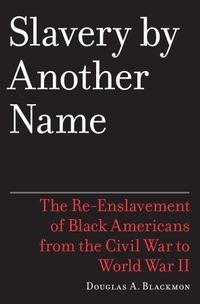
Slavery by Another Name: The Re-Enslavement of Black Americans from the Civil War to World War II
A North American Hi..., Nonfiction, African American book. The brutal forms of physical punishment employed against prisoners in...
In this groundbreaking historical exposé, Douglas A. Blackmon brings to light one of the most shameful chapters in American history—an “Age of Neoslavery” that thrived from the aftermath of the Civil War through the dawn of World War II.Under laws enacted specifically to intimidate blacks, tens of thousands of African Americans...
Download or read Slavery by Another Name: The Re-Enslavement of Black Americans from the Civil War to World War II in PDF formats. You may also find other subjects related with Slavery by Another Name: The Re-Enslavement of Black Americans from the Civil War to World War II.
- Filetype: PDF
- Pages: 480 pages
- ISBN: 9780385506250 / 385506252
SJYZEUtuYDW.pdf
More About Slavery by Another Name: The Re-Enslavement of Black Americans from the Civil War to World War II
1900, the Souths judicial system had been wholly reconfigured to make one of its primary purposes the coercion of African Americans to comply with the social customs and labor demands of whites. It was not coincidental that 1901 also marked the final full disenfranchisement of nearly all blacks throughout the South. Sentences were handed down by provincial judges, local mayors, and justices of the peaceoften men in the employ of the white business owners who relied on the forced labor produced by the judgments. Douglas A. Blackmon, Slavery by Another... The brutal forms of physical punishment employed against prisoners in 1910 were the same as those used against slaves in 1840. Douglas A. Blackmon, Slavery by Another Name: The Re-Enslavement of Black Americans from the Civil War to World War II Dockets and trial records were inconsistently maintained. Attorneys were rarely involved on the side of blacks. Revenues from the neo-slavery poured the equivalent of tens of millions of dollars into the treasuries of Alabama, Mississippi, Louisiana, Georgia, Florida, Texas, North Carolina, and South Carolinawhere more than 75 percent of the black population in the United States then lived. Douglas A. Blackmon, Slavery by Another Name: The Re-Enslavement of Black Americans from the Civil War to World War II
I am conflicted with rage and sorrow after finally finishing Douglas A. Blackmon's "Slavery by Another Name: The Re-Enslavement of Black Americans from the Civil War to World War II."The complicity of numerous Corporations (U.S. Steel, etc.) and our United States government in all its racist glory, that allowed the dirty South to continue... I read this for a Race and Diversity class in college and while the subject matter was fascinating and horrifying, the writing was lacking. The author focuses on the statement that every child learns in elementary school: Slavery ended after the Civil War - and proves how false that statement is. It was enlightening and terrible at... This book tells in chilling, almost-unbearable-to-consider detail the exploitation, brutality and inhumanity that loomed over every black person (and some poor whites) in the south for almost 100 years after the Civil War. Fortunately, the author names the white SOBs - most of them moneyed or in "law enforcement" or the court system...